Research

The evidence base behind HPI

HPI draws on published research across cognitive science, behavioral psychology, occupational health, and mindfulness science. This page presents the anchor publication, the six research domains the framework integrates, and the 16 named challenges it addresses.

Anchor publication

Where HPI draws its evidence from

About this paper

This paper introduces HPI as an integrative framework synthesizing research from cognitive science, behavioral psychology, and occupational health. It explains how human performance emerges, degrades, and can be sustained in AI-enabled work environments.

The paper provides both a conceptual model and a practitioner-facing diagnostic logic grounded in the five dimensions the framework measures.

Every diagnostic dimension and every program maps back to one of these 16 challenges.
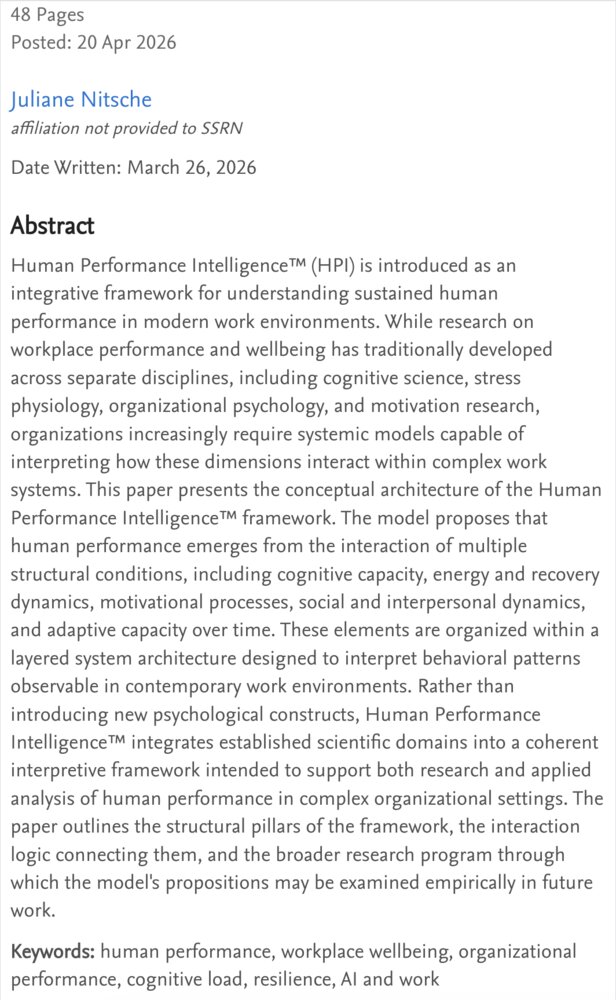
HPI paper on SSRN
SSRN Paper
Introducing Human Performance Intelligence™: A Framework for Understanding Human Capability in AI-Enabled Work Systems
Nitsche · Moutier · 2026
Field observations

Observations from practice

All posts
The five AI implementation stages

Every organization adopting AI moves through recognizable stages. Each has a distinct technical state, a distinct human reality, and a distinct set of programs that address it.

Stage name
Technology focus
Human focus
1
The Shadow AI Stage
Unsanctioned tools, no IT visibility, employees experimenting alone.
Anxiety rises before tools are sanctioned. Habits form in the absence of guidance.
2
The Copilot Chaos Stage
Tool licensed but no rollout playbook. Managers and employees self-discovering.
Confusion replaces clarity; effort doubles instead of halving.
3
The AI Reality Shock Stage
AI starts exposing process gaps and weak workflows the org had been tolerating.
Emotional defensiveness, identity threats, fairness questions emerge.
4
The Acceleration Pressure Stage
Tooling acceleration outpaces the organization's adaptive bandwidth.
Chronic strain becomes the default state. Performance degrades silently.
5
The Human-Centered AI Organization
AI is embedded; the new sustaining question is how to keep humans performing.
Sustained performance becomes the design goal, not the survival goal.
Diagnostic dimensions

The five conditions HPI measures

Each dimension maps to a specific failure mode observed across the five stages.

01
AI Awareness
Whether the organization has a clear, communicated position on what AI is and what is expected. Absence creates anxiety that fills with rumor.
02
Manager Readiness
Whether managers can lead AI-related team conversations. Highest leverage per training hour because managers cascade what they know.
03
Habit Formation
Whether employees are forming constructive or destructive AI work habits. Destructive habits form early and take months to retrain.
04
Governance & Security
Whether teams understand what data can go where. The most costly incidents trace back to governance gaps, not technical failures.
05
Wellbeing & Fatigue
Whether cognitive load and recovery are being tracked. Performance degrades silently before it becomes organizationally visible.